
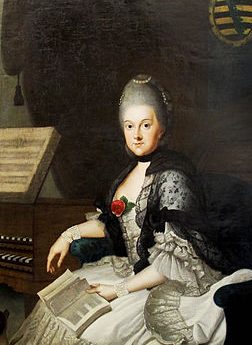
Anna Amalia of Brunswick-Wolfenbüttel, known also as the duchess of Sachsen-Weimar-Eisanach, was a German princess and classical composer. She is remembered in the clarinet community for her two-movement divertimento for clarinet, viola, cello, and piano (1780).
Anna Amalia (1739 – 1807)
Anna Amalia of Brunswick-Wolfenbüttel (24 October 1739 – 10 April 1807), was a German princess and composer.1 She became the duchess of Saxe-Weimar-Eisenach by marriage, and was also regent of the states of Saxe-Weimar and Saxe-Eisenach from 1758 to 1775. She transformed her court and its surrounding into the most influential cultural center of Germany.
As a patron of the arts, Anna Amalia drew many of the most eminent people in Germany to Weimar, including Johann Gottfried Herder, Johann Wolfgang von Goethe, Friedrich Schiller and Abel Seyler‘s theatrical company.2 When she succeeded in engaging the Seyler Company, this was “an extremely fortunate coup. The Seyler Company was the best theatre company in Germany at that time.”3 Amalia von Helvig was also later to be a part of her court. She hired Christoph Martin Wieland, a poet and translator of William Shakespeare, to educate her son. She also established the Duchess Anna Amalia Library, which is now home to some 1,000,000 volumes. The duchess was honoured in Goethe’s work under the title Zum Andenken der Fürstin Anna-Amalia.
Anna Amalia was a notable composer who studied harpsichord and piano with Gottlieb Hayne, and counterpoint with Johann Philipp Kirnberger.1 She also studied music with Friedrich Gottlob Fleischer4 and Ernst Wilhelm Wolf.5
Among her compositions is a divertimento for clarinet, viola, cello, and piano, composed in 1780. The score and parts survive, and are available in the public domain.
Works
Divertimento | 1780
Clarinet, viola, cello, piano
Download parts and score from IMSLP
Stay Informed! Sign up to receive word when we add new composers or works to our catalogue.
References
- Jezic, Diane (1988). Women composers : the lost tradition found. New York: Feminist Press at the City University of New York. ISBN 0-935312-94-3. OCLC 18715963.
- One or more of the preceding sentences incorporates text from a publication now in the public domain: Chisholm, Hugh, ed. (1911). “Anna Amalia“. Encyclopædia Britannica. 2 (11th ed.). Cambridge University Press. p. 59. This cites F. Bornhak, Anna Amalia Herzogin von Saxe-Weimar-Eisenach (Berlin. 1892).
- “Herzogin Anna Amalie von Weimar und ihr Theater,” in Robert Keil (ed.), Goethe’s Tagebuch aus den Jahren 1776–1782, Veit, 1875, p. 69
- “Search Results for Anna Amalia | Grove Music Online | Grove Music”. Grove Music Online. Retrieved 2021-02-14.
- Baker’s biographical dictionary of musicians. Nicolas Slonimsky, Laura Diane Kuhn, Nicolas Slonimsky (Centennial ed.). New York: Schirmer Books. 2001. ISBN 0-02-865525-7. OCLC 44972043.
Notes
Publication date:
This page was last updated 3/7/2021

About us
We are dedicated to the preservation and performance of music by women.
 Clarinet Music By Women